First conditional
Nature: Open condition, what is said in the condition is possible.
Time: This condition refers either to present or to future time.
e.g. If he is late, we will have to go without him.
If my mother knows about this, we are in serious trouble.
Second conditional
Nature: unreal (impossible) or improbable situations.
Time: present; the TENSE is past, but we are talking about the present, now.
e.g. If I knew her name, I would tell you.
If I were you, I would tell my father.
Compare: If I become president, I will change the social security system. (Said by a presidential candidate)
If I became president, I would change the social security system. (Said by a schoolboy: improbable)
If we win this match, we are qualified for the semifinals.
If I won a million pounds, I would stop teaching. (improbable)
Third conditional
Nature: unreal
Time: Past (so we are talking about a situation that was not so in the past.)
e.g. If you had warned me, I would not have told your father about that party.(But you didn’t, and I have).
Remember!!!!!!!!!!!!!!
1. The conditional construction does not normally use will or would in if-clauses. EXCEPTION: If will or would express willingness, as in requests, they can be used in if-clauses.
e.g. If you will come this way, the manager will see you now.
I would be grateful if you would give me a little help.
(= ± please, come this way; please, give me…)
2. For the second conditional, were replaces was:
If I were a rich man…
3. After if, we can either use «some(-one, -where…)» or «any(-one, -where…).
If I have some spare time next weekend….or :
If I have any spare time…
4. Instead of if not, we can use unless.
e.g.
5.There is a «mixed type» as well, for the present results of an unreal condition in the past:
If + Past Perfect – would + inf.
e.g. If you had warned me [then], I would not be in prison [now].
SUMMARY

http://www.mansioningles.com/Gram42.htm


 This car was made in 1963. (passive)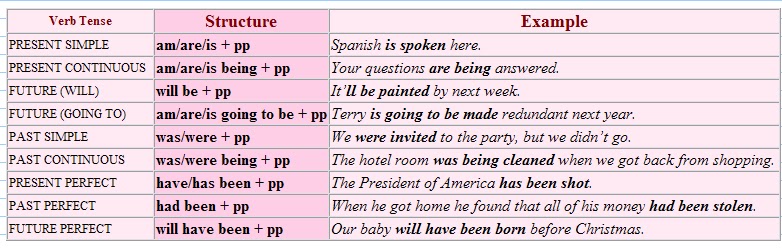


 English